





The award ceremony of the “SDGs Design International Awards 2025” was successfully held with great enthusiasm.
A total of 430 entries were submitted from 46 countries and regions, expanding the international platform for dialogue on sustainable design.
About the SDGs Design International Awards 2025
Creating a global platform to discuss “Social Design Beyond Boundaries: Living Together in an Age of Conflict.”
The SDGs Design International Awards 2025 Executive Committee (Kyushu University, Dongseo University, and Tongji University) announced on December 11 (Thu) that the award ceremony for the SDGs Design International Awards 2025 was held successfully.
This international design competition, centered on the United Nations Sustainable Development Goals (SDGs), serves as a global creative platform for university and high school students worldwide. This year’s theme was “Social Design Beyond Boundaries: Living Together in an Age of Conflict.”
Supported by the RISE (Responsible Design for Environment and Empowerment) initiative at Dongseo University, the competition has established itself as a leading program that connects regions, industries, and education while fostering global design capabilities.
This year’s competition focused on three key areas:
・Design for Peace
・Designing with Marginalized Voices
・Living Between the Virtual and the Real
Submissions spanned diverse fields including visual design, environmental design, fashion, product design, architecture, urban planning, engineering, and social innovation. Numerous creative ideas addressing pressing social challenges were presented.
430 Entries from 46 Countries and regions Strengthen Its International Standing
A total of 430 submissions were received from 46 countries and regions, 99 universities, and 15 high schools, reaffirming the competition’s status as a truly international contest.
This year, many works reinterpreted global issues such as war, climate crisis, and social division through the lens of design, drawing significant attention from the jury panel.
Three-Stage Evaluation Process
All submissions underwent a three-stage review process—preliminary screening, first-round evaluation, and final judging—throughout November.
Design experts from Japan and abroad participated in the evaluation. Entries were comprehensively assessed based on criteria including creativity, social value, feasibility, and overall design quality.
“A Platform to Envision a Sustainable Future Beyond Boundaries”
The Executive Committee commented:
“This year’s competition provided a highly meaningful opportunity to reflect on how we can coexist in an age of conflict and what kinds of social alternatives design can offer. Moving forward, we will continue to develop this platform as a space where international creative talents can collaborate toward achieving the SDGs.”
The final award-winning works are published on the websites of the College of Design at Dongseo University and the Asia Future Design Institute.
Results Announcement
■Gold Award Winner
Link-it: Fostering Sustainable Independence
Through Peer Partnership
TEAM: Min seo Kim, Seo jung Park (Visual Communication Design, University Of Ulsan, Korea)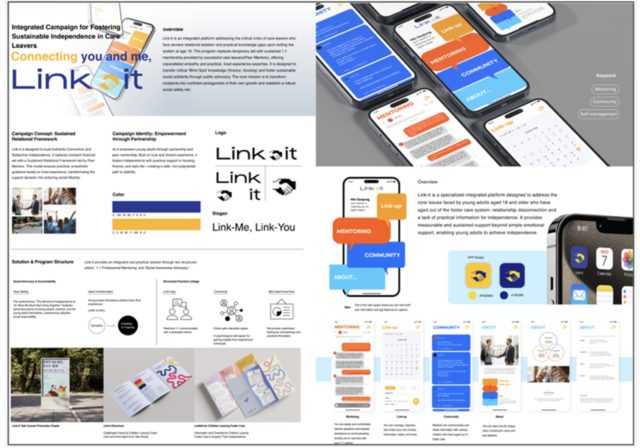

Link-it is a specialized social design initiative confronting the systemic instability faced by young adults transitioning from institutional care (care leavers) upon aging out at 18. This project aligns with the themes of “Social Design in Partnership with Marginalized Voices.” The target population is uniquely vulnerable due to the abrupt termination of both financial and, critically, relational support networks. Link-it proposes a fundamental redesign of this support model, moving beyond temporary aid to establish a Sustained Relational Framework. Our primary innovation is the implementation of a Peer Mentorship System. This involves rigorously selecting and training successfully independent care leavers to serve as trusted guides. This strategy utilizes lived experience as a form of expertise, ensuring an immediate, deep bond built on shared understanding-a resource traditional mentors cannot easily replicate. The core of this system is dedicated digital platform, the Link Channel, which provides a secure, reliable lifeline for real-time consultation, crucial for minimizing errors during high-stakes decisions like lease agreements or financial planning. This comprehensive approach is designed to transform systemic vulnerability into sustainable personal resilience and establish longterm, reliable Allyship across societal divides. Link-it provides structured, empathetic guidance to empower care leavers to become autonomous agents of their own stable futures.
■Silver Award Winner
Order
Team: Bitna Tak, Sinii Joung, Minsu Kim
(Design Innovation/Visual Communication Design, Sejong University, Korea)

Order is a wearable communication device designed to empower older adults who face social isolation and digital barriers. The primary aim of Order is to bridge the digital divide and strengthen human connection, supporting seniors to confidently access digital public services and actively participate in daily life. Order combines a brooch-shaped smart camera, which instantly reads and interprets information from kiosks or printed materials, with AI-powered hearing aids that deliver clear, real-time voice guidance. This solution dramatically reduces confusion and dependency for elderly users, especially those with hearing loss or low digital literacy. The device’s innovative, voice-based interface transforms digital complexity into a familiar “ask and listen” experience, inspired by the natural flow of human conversation. Through a human-centered design, Order restores autonomy, combats loneliness, and encourages social engagement among older adults. By making real-time digital information accessible through spoken explanation, Order supports both online and offline communication, enabling seniors to interact more independently wherever they are. Ultimately, Order presents a scalable, inclusive model for digital adaptation that directly contributes to reducing social isolation and advancing the SDGs in an aging society.
■Bronze Award Winner
Seasons Under Glass: Accessible Indoor Gardening for Lifelong Well-Being
Yuanzi Wu
(Pratt Institute, Tetsu Ohara, US) 

This project supports SDG 3 (Good Health and Well-being) and SDG 11 (Sustainable Cities and Communities) by creating an inclusive indoor gardening system that promotes physical health, mental clarity, and social connection among seniors and physically challenged residents in Hudson, New York. In Hudson, long cold seasons—lasting over three months—restrict outdoor activity and contribute to social isolation among the elderly. This project addresses the scarcity of accessible indoor activity spaces by transforming underutilized community areas into year-round therapeutic gardens. These spaces are designed with height-adjustable raised beds (24–36 in), enabling comfortable participation for individuals with mobility or balance limitations, including wheelchair users.The system integrates aromatherapy, sensory planting, and shared healthy-diet activities to enhance multisensory engagement—stimulating sight, smell, touch, and taste. Beyond physical activity, the gardens become social hubs where residents can share experiences, converse face-to-face in greenery, and reconnect through nature. By combining accessibility, modular design, and sensory well-being, this project offers an innovative, inclusive approach to aging-in-place and community resilience, redefining how built environments support wellness for all generations.
■Special Award for High School Students
Mind Bridge: A Virtual Friend for Real Teens
— Get Close to Their Minds
Wenfan Sha, ZiHan Qi, (Beijing Navigation School)
Our mission with MindBridge is to alleviate the pervasive sense of panic and anxiety that many teenagers experience as dusk falls each day—be it from the overwhelming pressure of unfinished homework or the accumulated stress of a difficult day. We specifically target adolescents, a group whose emotional needs are often overlooked.A key attraction of our product is its unique, customizable shell, produced using eco-friendly 3D printing technology. This allows users to express their individuality by switching to a design that resonates with them, making the device not just a tool, but a personal and sustainable companion.We believe our core innovation lies in addressing two critically neglected areas. First, we recognize that teenagers are not a monolith, they crave and deserve personalized AI services that adapt to their unique emotional and academic needs. Second, we pinpoint and address the “sunset anxiety”—a specific time-triggered emotional low that is rarely acknowledged. Through MindBridge, we aim to bridge this gap in awareness, demonstrating how technology can be thoughtfully harnessed to foster genuine concern for adolescent mental well-being, transforming a time of dread into a moment of supported reflection.
Team roster: https://uni.dongseo.ac.kr/adcf/index.php?pCode=MN8000043&mode=view&idx=1056