





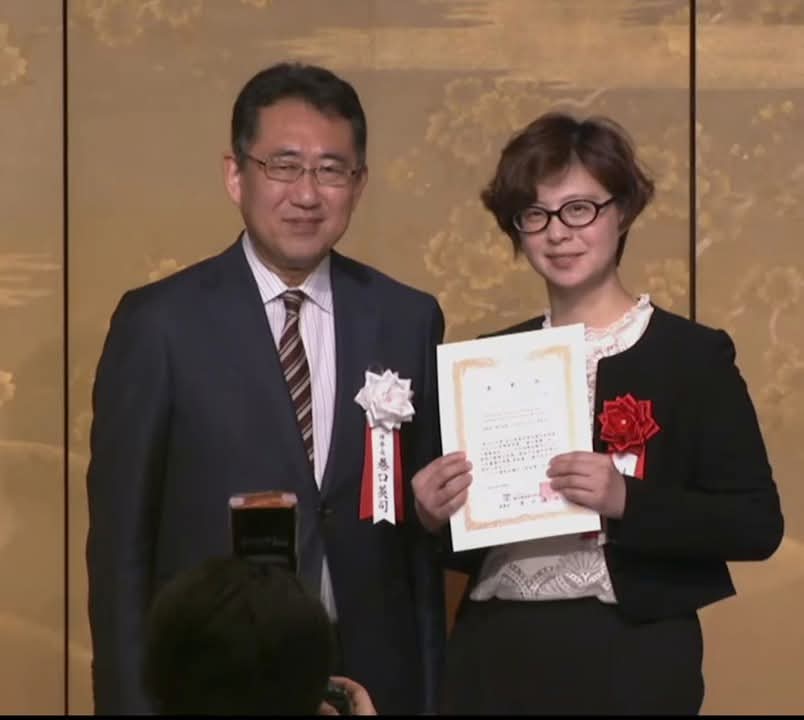
Research from Hsin-Ni Ho Lab (Faculty of Design, Kyushu University) has received the Telecom Interdisciplinary Research Award (Encouragement Prize) from the Telecommunications Advancement Foundation, Japan. This award recognizes outstanding interdisciplinary research in the field of information and communication technologies and is granted through a competitive selection process from a large pool of submissions from Japan.
The awarded paper is an international collaboration between Kyushu University, Yamaguchi University, and the Massachusetts Institute of Technology. The study focuses on the temporal integration of tactile and thermal perception. The award ceremony was held on March 26, 2026, at the Imperial Hotel Tokyo.
Authors:
Takuya Jodai (Kyushu University), Masahiko Terao (Yamaguchi University), Lynette A. Jones (MIT), Hsin-Ni Ho (Kyushu University)
Title:
Perceiving Synchrony: Determining Thermal-tactile Simultaneity Windows
Journal:
IEEE Transactions on Haptics
DOI: 10.1109/TOH.2024.3452102
This study investigates how tactile and thermal signals are perceived as simultaneous depending on their temporal relationship. The findings provide design guidelines for haptic interfaces grounded in human perceptual mechanisms and are expected to contribute to the development of next-generation communication technologies capable of conveying the realism of touch across distance.
The awarded paper is an international collaboration between Kyushu University, Yamaguchi University, and the Massachusetts Institute of Technology. The study focuses on the temporal integration of tactile and thermal perception. The award ceremony was held on March 26, 2026, at the Imperial Hotel Tokyo.
Authors:
Takuya Jodai (Kyushu University), Masahiko Terao (Yamaguchi University), Lynette A. Jones (MIT), Hsin-Ni Ho (Kyushu University)
Title:
Perceiving Synchrony: Determining Thermal-tactile Simultaneity Windows
Journal:
IEEE Transactions on Haptics
DOI: 10.1109/TOH.2024.3452102
This study investigates how tactile and thermal signals are perceived as simultaneous depending on their temporal relationship. The findings provide design guidelines for haptic interfaces grounded in human perceptual mechanisms and are expected to contribute to the development of next-generation communication technologies capable of conveying the realism of touch across distance.