





The sound installation by Daryl Jamieson is presented as part of the research activities of Associate Professor Madoka Yuki and Lecturer Ariane Beyn of the Faculty of Design.
Venue: The Kyushu University Museum, Hakozaki (Garden)
Date & Time: Saturday-Sunday, May 16/17th, 23/24th 2026, 10am – 4pm
Target Audience: general public
Supported by the Grants-in-Aid for Scientific Research (KAKEN) and the Kuma Science Engineering and Culture Promotional Foundation
Cooperated by Kyushu University Museum
Daryl Jamieson’s work weaves together human experience, memory, urban and technological change, and environmental conditions in compositions and sound installations that often take a specific location as their point of departure. His work is influenced by Japanese traditional art forms—particularly Noh theatre and poetry—as well as practices such as psychogeography and John Cage’s notion of “silence”.
Created for the garden of the Hakozaki Satellite of Kyushu University during Fukuoka Museum Week 2026, the sound installation …through the pines unfolds as a walk along the garden’s stone river. Recordings made in and around Kyushu University’s historic campus, now undergoing redevelopment, are played through loudspeakers and intermingle with ambient sounds of airplanes, construction, wind, and birds.
According to Jamieson, the speakers are arranged as three imagined zones of a river. The “upstream zone” features birdsong recorded right there in the museum garden and among old pine trees remaining on the former campus, alongside ambient sounds from the museum’s distinctive tower. The “downstream zone” presents ‘water-related’ recordings from inside the museum—such as a living aquatic insect kept in a tank—and heavily distorted excerpts from Claude Debussy’s La Mer (1905) (itself partly inspired by Hokusai’s The Great Wave off Kanagawa), played from a shellac record on a historical player from the museum collection. The “ocean zone” includes recordings from Hakozaki Beach captured under varying weather conditions, as well as sounds from the museum’s basement at sea level, evoking the site’s former proximity to the sea before industrial-era land reclamation.
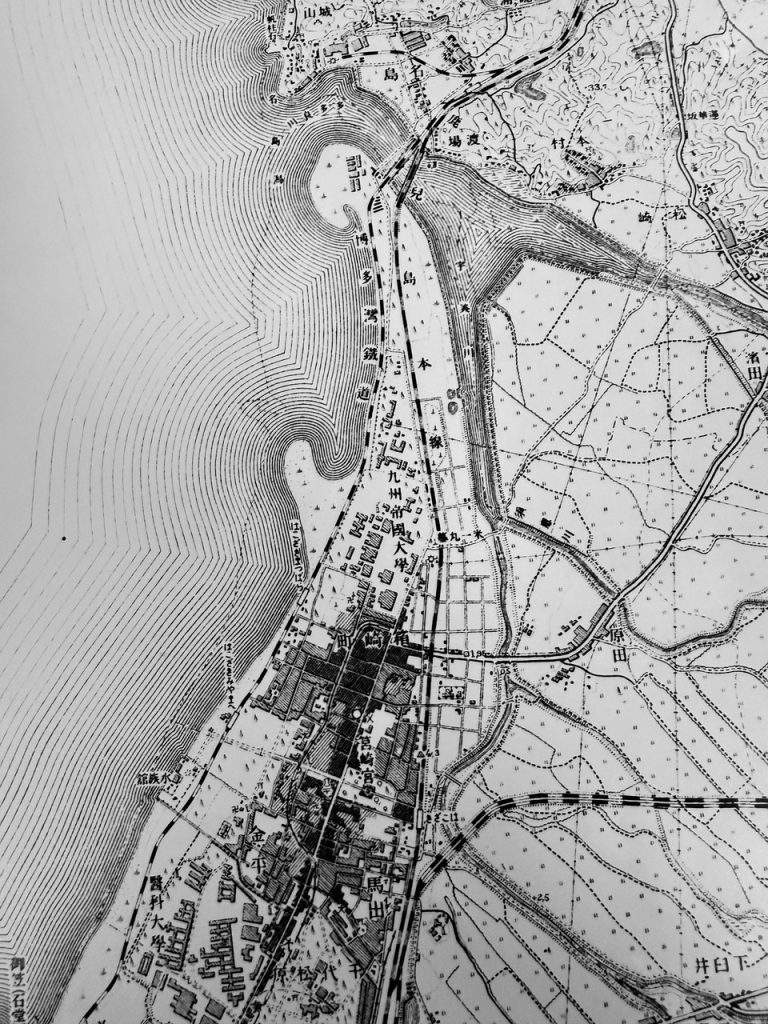
The museum building itself—formerly the main building of the School of Engineering of Kyushu Imperial University—embodies this transformation. Its construction in 1930 marked a decisive incursion into what was then a rural coastal landscape, reflecting broader processes of modernization that continue to reshape the area today.
All these references and layers of history are incorporated into Jamieson’s installation; however, the overall impression is less about citation than about a carefully composed interplay of diverse sounds—silence and noise alike—interacting with their unpredictable surroundings and unfolding through the visitor’s movement.
Daryl Jamieson (*1980, Halifax, Nova Scotia, Canada) is a composer, Visiting Professor of Composition at Aichi University of the Arts and researcher at Ritsumeikan University, Kyoto. He studied composition at Wilfrid Laurier University with Glenn Buhr and Linda Catlin Smith, and later in the UK with Diana Burrell and Nicola LeFanu. After moving to Japan in 2006, he studied under Jo Kondo. From 2020-2025, he was Assistant Professor at the Faculty of Design, Kyushu University.
Jamieson’s sound installations have been exhibited in Tokyo, Reykjavík, and London, and his concert music has been performed internationally. Among his largest projects to date is the trilogy of music theatre works The Vanitas Series, which received the Toshi Ichiyanagi Contemporary Prize in 2018.
In 2013 he founded the musical theatre company atelier jaku. His four-disc album Descants was recently released on atelier jaku records. As a researcher, he writes on 20th-century Japanese philosophy, contemporary music, and spirituality. His first monograph, Experimental Music and Japanese Aesthetics: Silence, Nature, and Hollow Listening, will be published in 2026.
Image source:
https://service.gsi.go.jp/map-photos/app/map?search=map&id=1330449&search_date_from=0000&search_date_to=9999#4/33.628286897/130.438056028
(last accessed May 15, 2026)